Projects planned at present
Some proposed projects which are submitted by some trustees and life members are at preliminary stage of consideration. But they provide type of direction in which this institute is planning to work. Some projects are briefly mentioned below:
Monthly lectures
List of monthly lectures delivered till now:
Four lectures have been delivered by well known scientists and academicians through zoom channel: The details are given below:
- Artificial Intelligence by Rajeev Malhotra
- Corona (Covid 19 pandemic), by Dr. Navneet Shah and PadamShree Dr. Sudhir Shah on April 24.
- Developing Unconventional, Innovative, Simple and Cost-Effective Strategies to Manage Corona Virus Pandemic – Role of 2-deoxy-D-Glucose, by Dr. Viney Jain On June 1, 2021.
- Periodicity of redshift and new challenge to Big Bang Cosmology, by Prof. Sisir Roy, of National Institute of Advanced Studies, Bangalore on June 15, 2021
Promoting science in schools and public:
A DST sponsored Project for school children: Learning Science While Playing:
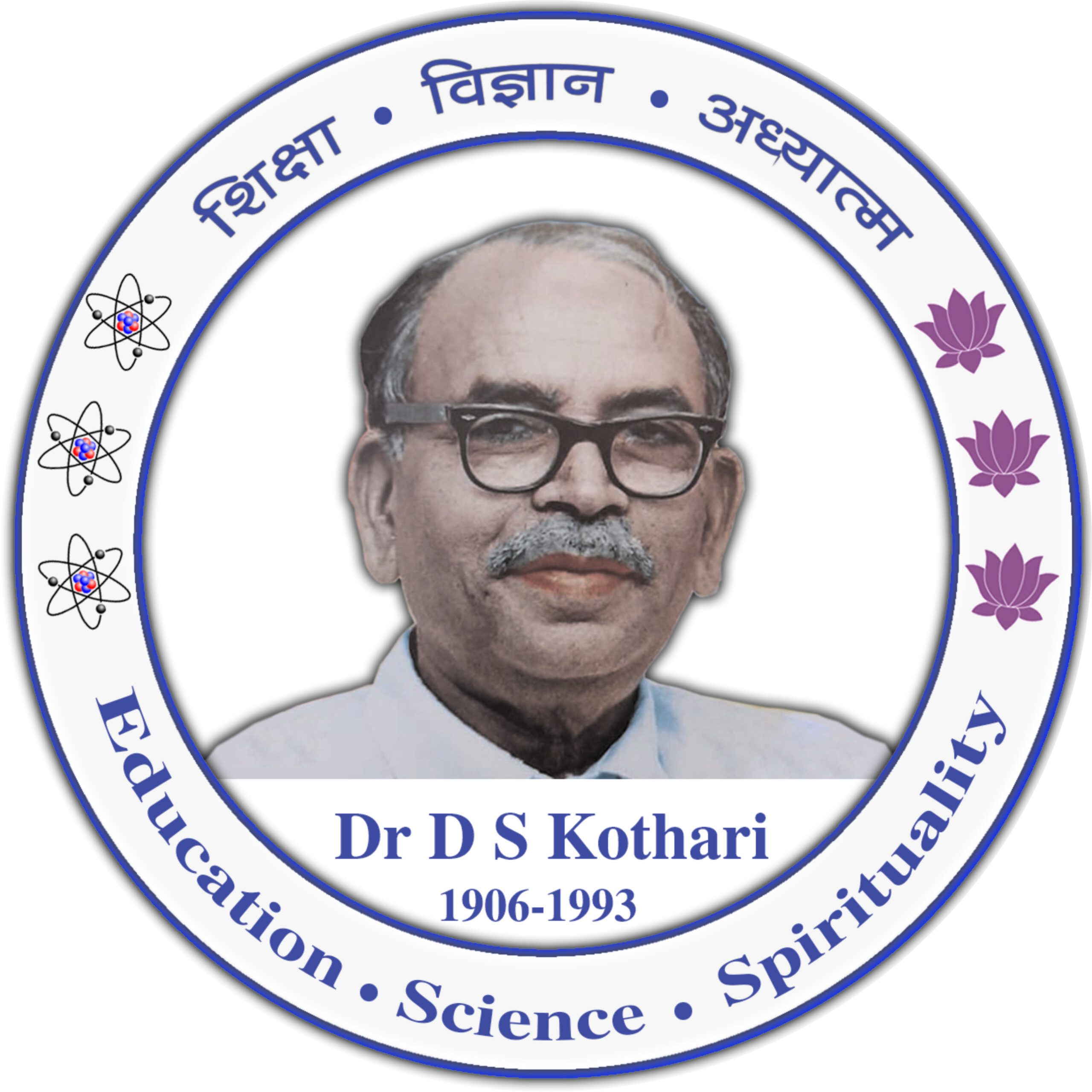
Dr. D S Kothari was very keen in improving science education among children right from early childhood. So this Project is proposed to be carried out in collaboration with Manthan Educational Programme Society, Ahmedabad (Gujarat) India, being Supported by National Council for Science & Technology Communication (NCSTC), Department of Science and Technology, Government of India.
This project is an attempt to showcase traditional toys from India and also to try and explain the scientific principle behind the toys. Keeping this core theme of the project, the entire project was designed. From the bamboo whistles to the ones made of mud and clay, Indian toys employ a lot of scientific principles within them. These toys have a rich science behind them and are made from locally available sustainable materials.
Under this project children are motivated to learn science in a way that are creative and fun. The kits developed under the project “Learning Science While Playing” will act as a resource material for schools and individual students, group of students as well as teachers to help them learn science by doing in a multidimensional manner.
500 sets of Hands-on Science Kits (Total 2000 kits) were received for elementary classes. In addition, a total of 100 Hands-on Kits and 10 Learning Resource Box for exhibition have been provided by Manthan which have already reached Office of the institute. Due to covid problem no action could be taken. Work will shortly begin now. This project will be taken up in association with District Education officer of Udaipur for some selected schools around Udaipur.
Mentoring students to become Scientists of Excellence:
Producing world class scientists in India
Dr. Kanak Madrecha, an industrial engineer and our trustee from Dubai is working towards a plan to improve the quality of higher education through this institute. It is being planned so that India can also produce top class scientists by identifying children and youths at an early stage and grooming them up by motivating them to work with eminent scientists of India and outside. This will be planned in association with Dr. Naresh Kumar who will be technical advisor. Dr. Naresh Kumar is Ph d from Tata Institute of Fundamental Research (TIFR) and was a Dean of life sciences in NIRMA, Ahmedabad. He is basically a Biochemist and has worked in University of Baroda. Funds will be managed through Deptt. Of Science and Technology and corporate houses. The detail plan is under preparation by Dr Madrecha and Dr. Naresh Kumar.
Promoting science in schools and public
Project to work with Agastya foundation to popularize science education in villages:
Engineer Shri Karan Samota, Shri Karan Madrecha, Shri Manish Mehta and Dr. Deepika Kothari have proposed a outreach science education project in collaboration with Agastya International Foundation, Bangalore. For this a couple of meetings were held with the Agastya foundation. A mobile science van having a setup of a large number of hands on science experiments, models & two fully trained instructors is proposed to travel in 25 km radius of the Dr. D S Kothari Institute in Government schools, selected with approval of District Education authorities. It has a targeted exposures to 16000 students & 150 teachers in one year. The whole idea is to spark curiosity, nurture creativity & build confidence among economically disadvantaged children & teachers. The Agastya Foundation has done good research and developed a large number of kits for this purpose & are running several projects for over 21 years in 22 Indian states. The execution of this project will immensely benefit rural children. The project involves around Rs. fifty lakhs for about three years, so the talks are in progress to start work in this direction with sponsors. Some industrialists have shown interest through their CSR activity and are ready to provide some seed money for this project.
Science Discovery Center in a village:
Er Rajendra Kumar Chatur made a proposal of setting of a Science Discovery Center in a nearby village. For its execution, he proposed an action plan and to constitute a committee which can identify about 3 Bigha land & other resources mobilisation like a van, technical manpower, office construction etc. A detailed Project Report (DPR) will be prepared.
Project for utilization of waste from mines around Udaipur:
Er S C Vaid has initiated a project-process technology for utilization of the industrial waste This does not involve any investment, but only a liasioning work between industry, university & CSIR type labs. To start with local industries like Hindustan Zinc, Rsmml, Wolkem , Jindal will be contacted by him & idea will be extended to them for possible mutually win-win collaboration in finding solution to their problems.
A project for counting types of trees in different parts of Udaipur:
Dr. Ashok Kumarji Singhwi brought to our notice a work done in Chandigarh and described in a book “Tree treasure of Chandigarh “. This book is authored by Prof Ravindra Kohli, renowned botanist. It is about a project done under his guidance, on history of various types of trees spread in city of Chandigarh. Er Karan Samota made a suggestion based on this work that a similar project can be initiated in Udaipur also. This project will generate an interest in environment & tree plantation & associated knowledge. This project will be explored in collaboration with the help of M Sc students of university.
Work on consciousness:
Dr. D S Kothari Sahab had given a problem to Dr. Surendra Singh Pokharna to understand relation between soul and matter in general and how a non-material soul can interact with matter in particular. This problem was there in his mind from several years. About four years ago a project was sanctioned to Dr Pokharna entitled “A comparative study between the concept of consciousness in modern science and Jainism” by the Indian Council of Philosophical Research (ICPR). A project report is in a final stage of submission.
Celebration of UN declared International Non-violence day on October 2:
Summary of the project
- United Nations has declared October 2, the birth day of our Father of Nation, Pujyaniya Mahatama Gandhi as an International Non-Violence Day.
- Non-violence is required because in last forty years, half of animals and insects have died due to human activities, climate change and other factors.
- Around 25,000 biological species are getting extinct every year.
- Every year about 15,000 crores (150 billions) animals are killed every year for food and related human activities. (www.occupyforanimals.net/animal-kill-counter.html)
- Production of non-vegetarian food requires around 10-20 times more land and water, which are a big danger on our environment and ecology.
- By 2050, the number of animals and insects would be so less that people would be forced to become totally vegetarian.
- The modern economic concept of development needs to be critically examined in the light of concepts like spiritual development.
- The recent example in Nepal to stop killing of lakhs animals every five year to stop it from now onwards, should be replicated in other countries.
- The recent studies in science for understanding of consciousness indicates that a soul like entity may exist as a quantum gravity phenomenon and could be a basis for underlying unity among all living beings. This also implies a need towards non-violence at all levels.
- Several religious and spiritual leaders are expressing grave concern on these issues and pledging people to take timely action, before it is too late.
- All 192 member countries of United Nations should celebrate this day in their own way.
- India should take a big lead in this direction as our country has long history towards implementation of the concept of non-violence since thousands of years. In addition, we have already celebrated International yoga day on a global scale.
“Indian Civilization – Continuities & Change”
Documentary Series has 18 Episodes in Hindi & English.
An excellent series of video films have been made by Dr. Deepika Kothari and her team. Dr. Deepika is the grand daughter of Prof. D S Kothari Sahab and daughter of Dr. Lalit Kumarji Kothari. Her films are very popular and are shown world over in general and many educational institutions and corporates in India. Some brief details are given below:
Dr. Deepika Kothari is PhD in Physics, made this film series along with her team. Presently she is involved in making research based documentary films on wisdom of Indian Civilization. Their 1st film “History of Yoga” was screened at various IITs, IIMs, IISc, etc..and in the US, MIT to Google HQs at 31 places including many Universities. MEA, GoI had screened it at all Missions abroad in 2015, 2016. It was screened at DD National, DD Bharati, LSTV channels.
The Documentary series depicts, for the first time, the continuities of Cultural Traditions, Knowledge systems and Philosophical thoughts of India from the perspective of Philosophy of Yoga. It also establishes the civilizational values of mutual respect and reverence for Nature.
The narrative of India is about the creation of the highest form of civilization on Earth and later its destruction to a great extent.
It is deeply researched, rightfully interpreted and beautifully filmed, from across India & world sites and Museums.
With the contribution of 30 eminent scholars, this 19 Episodes series shows India’s magnificent Iconography, Temple Art, Diverse Cultures, Ancient Relics, Wall paintings, Manuscripts, Meditative Music & Dance with the wisdom of India, in the most enthralling & entertaining way.
YouTube Channel : Vishuddhi Films
Producer
Shri Suraj & Vallabh Bhanshali
Directors
Dr Deepika Kothari & Ramji OM, IRAS
Production
Vishuddhi Films
Desh Apnayen S Foundation
Website- www.vishuddhifilms.com
You Tube Channel : Vishuddhi Films
Trailer – “Indian Civilization: Continuities & Change”(3mins,English)
ट्रेलर – भारतीय सभ्यता : सातत्य और परिवर्तन ( 3 mins )
Indian Civilisation Hindi Episodes
Indian Civilization English Episodes
History of Yoga Film Series
Vishuddhi Films
===========================
देखें वृत्तचित्रों की श्रंखला
‘‘ भारतीय सभ्यता – सातत्य एवं परिवर्तन’’
यह श्रृंखला भारतीय सभ्यता का सिंहावलोकन, भारतीय दृष्टि से करती है। श्रैेष्ठतम विद्वानों के योगदान से यह सम्भव हुआ है।
इसका उद्धेष्य भारत के ज्ञान-विज्ञान, कलाओं और जीवन के वैज्ञानिक व आध्यात्मिक महत्व को प्रमाणिक रुप से प्रस्तुत करना है।
महारास की भारतीय संस्कृति की यह भव्य प्रस्तुति केवल मंत्रमुग्ध नहीं करती। भविष्य के लिए नई दृष्टि देती है।
भारत की सांस्कृतिक निधि इतनी विषाल है कि कई दषकों के अनुसंधान और पांच वर्षों के निर्माण के बाद भी हम इसका सार ही प्रस्तुत कर पाए हैं।
इस गाथा को कहने का उद्धेष्य मष्तिष्क को ज्ञान से भरना नहीं है। मन को कलाओं से मोहित करना भी नहीं है। यह सुहदय दर्षकांे की आनन्दमय रुपान्तरण यात्रा है।
भारतीयों के स्वस्थ जीवन का आधार उनकी समग्र दृष्टि रही है।
अखण्ड दृष्टि का पुननिर्माण कठिन है। लेकिन अपनी सभ्यता के पुननिर्माण की अदम्य इच्छा भारतीयों के मन में आज भी है। कुछ भारतीय आज भी प्राचीन सभ्यता के उच्च स्वरुप को बनाए रखना चाहते हैं। इस फिल्म का निर्माण उसी इच्छा का परिणाम है।
विषेष:
ऽ 18 कड़ियां, हिंदी और अंग्रेज़ी में।
ऽ 10 वर्षो का अनुसंधान और फिल्मांकन
ऽ 141 भारतीय स्थल, संग्रहालय और पुस्तकालय
ऽ 52 विदेषी स्थल और संग्रहालय
ऽ 30 उच्चकोटि के विद्वानों का योगदान – इतिहास, दर्षन, पुरातत्व, संस्कृत, कला, मस्तिष्क विज्ञान, योग आदि क्षेत्र से।
ट्रेलर – भारतीय सभ्यता : सातत्य और परिवर्तन
भारतीय सभ्यता, हिन्दी श्रृंखला https://youtube.com/playlist?list=PLJaEmaHm0OAD8wlQxTZJbLp9EXr1R7QfO
Multidisciplinary Researches and studies:
If we look at the total work done by Dr. Kothari and his overall contribution to science, technology, education , defense and our country as a whole, then it is obvious that his overall perspective was multidisciplinary without which it is not possible to work in so many areas and establish so many institutions. This is one of the biggest idea, we can learn from Kothari Sahab. This is incidentally more relevant today then what it was at that time.
Multi disciplinary studies are necessary as this is an intrinsic property of nature. Nature has processes which are interconnected among them. A tree can grow only in presence of good seed, good fertile soil, good sunlight, regular supply of water, good quality of air and so on. There is some balance also among them. But we have divided these areas into soil science, water resources management, solar energy studies, study of atmosphere and climate etc. Now each subject is also important and balanced studies of all taken together is also equally important.
Let us take another example which provides appearance of new properties when two or more than two things interact. Thus when Hydrogen and Oxygen combine then we get water, which is basic compound of life processes. Now many properties of water are not there in Hydrogen or Oxygen. These properties of water come into the picture only when Hydrogen and Oxygen combine in some fixed proportion. It implies that when these two gases combine then new properties comes into the picture which are not there in the original constituents. This is a consequence of interaction among the constituents. This is an example of how an interaction or addition of two different entities at microscopic level give rise to new properties and also a new perspective. Thus new properties are more than sum of the parts.
If we look at the problem of environment then we find that it is very complex problem and it involves many parts and many disciplines. Parts we have different countries or different constituents of Earth surface like ocean, land surface, forests, glaciers, agriculture land, atmosphere and their complex interactions. But still more important aspects are impact of human intervention on these features, and how this interventions and interactions are influencing the former system through social customs, concept of economic development, cultural factors and value systems prevalent in different societies. This whole problem therefore requires multidisciplinary studies.
We also find that a majority of new discoveries were based on combining two or more unrelated phenomena like, force and motion (momentum) by Newton, electricity and magnetism by Maxwell, wave and particle in quantum physics by De Broglie, Planck, Einstein and Neils Bohr. Even discovery of an apple falling down leads to discovery of gravity and so on. That thinking to link the two or more is very important. In the modern time, this has become very important to have multidisciplinary studies. These days many students prefer to do MBA after doing engineering in any discipline. This is an excellent example of need of multidisciplinary studies.
Another interesting example is study in the field of consciousness and to understand the life process from very fundamentals. Researches are going on in almost fifty or more disciplines to understand it. Some of them are neurophysiology, psychology, computer science, quantum physics, artificial intelligence, robotics, cognitive sciences, philosophy, cultural studies and so on.
This institute will take up research projects and will encourage students to understand the importance of multidisciplinary studies.
Assisting Government programmes:
Many types of Government agencies are encouraging NGOs, Private sectors to help the Governments through Public Private Public Partnership (PPP). So a mechanism will be developed to collaborate with some of these agencies and action plans will be developed and executed on regularly basis to support the welfare programs of Government for the society at different fields. Special focus will be laid to help the poorest of the poor, Bharat Swatchhata Abhiyan, IMplementatio of New Education Policy. It may be noted that Dr. D S Kothari chaired a committee and gave a new direction to education sector through what is known as “Kothari Commission Report). Now a new report has been prepared under the chairmanship of Dr. K Kasturirangan, former chairman of the Indian Space Research Organization. So the D S Kothari Institute will try to help the Education departments to implement the new Education Policy. Collaboration in other areas will be also explored over time.
To make science and technology directly relevant for the public, it is suggested that this institute would like to involve in the Master Plan for Udaipur 2031 and help the Government in implementing this plan for Udaipur.
Innovations in Science:
Innovations in science are urgently required and they will determine future destiny of any Nation in the twenty first century. Hence all efforts will be made to inculcate a love for innovations in daily life in general and science and technology in particular. Special efforts will be made to prepare students for the “National Level Science Talent Search Examination” and similar activities at National and international levels like olympiads organized in different subjects like Physics, Mathematics, Digital Technologies and English by different agencies. Students and children will be encouraged to participate in such examinations and possibilities of preparing the students in collaboration with school will be explored.
Souvenirs and Newsletters:
To communicate the developments of various projects and programmes, souvenirs and newsletters will be published. Souvenirs will be published on different occasions, whereas newsletters are being planned quarterly.
Training programmes:
Many types of training prgrammes will be conducted for students, youth, science teachers, common man, NGOs, Government departments and others for mutual benefit of each other and to also make these agencies upto date with the latest developments in science and technology.
Miscellaneous:
Some programmes will fall in this category which will be defined as and when required and not falling into the above categories like Shramdan for any social cause, tree plantation and others.